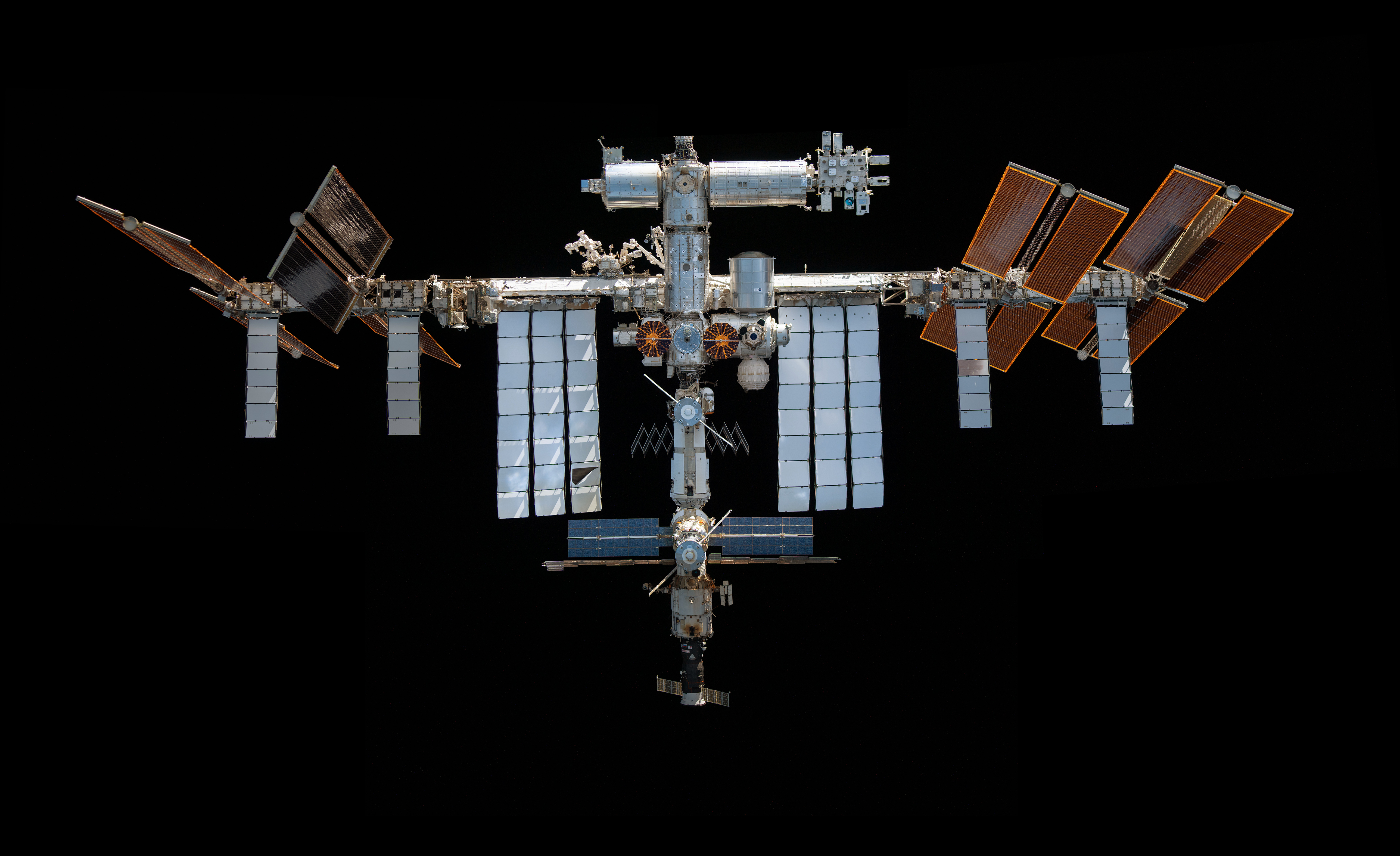
If you go outside to observe the night sky during right after sunset or right before sunrise, you will be able to spot satellites zooming around. They look like bright dots that move faster than an airplane. With a little bit of physics, you can calculate the height of a satellite without any special tools or instruments; you simply need to make some basic observations.
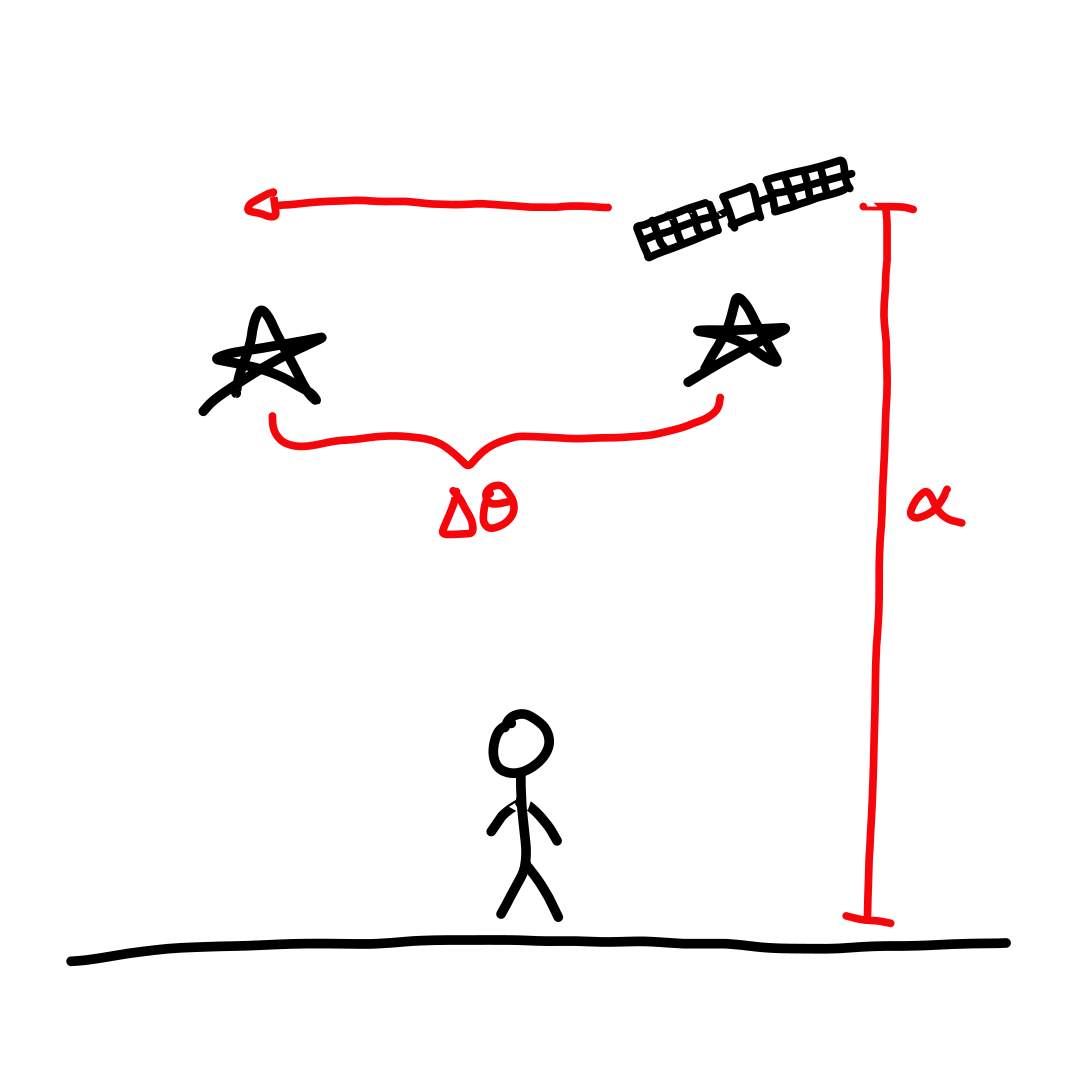
Once you spot your satellite, you need to measure how much time it takes to move between two stars. When I was outdoors observing the skies in the morning of 2023-01-29 at around 06:00, I spotted the satellite CZ-2C R/B, which I was able to identify with using Heavens Above. The satellite was coming from northwest, peaked north, and then moved east.
The satellite’s path crossed two familiar constellations. Using a star chart, I was able to determine that the satellite passed by Zeta Ursae Majoris, and moved towards Iota Herculis. The time it took to move between those two stars was $\Delta t = 52\,\mathrm{s}$.
The coordinates of the two reference stars are shown below.
- ζ-UMa: 13h 23m 56s; +54° 55’ 31”
- ι-Her: 17h 39m 28s; +46° 00’ 23”
From this, we can calculate the angular separation to be $\Delta\theta = 40.1^\circ$.
I estimated that the satellite had an altitude angle of $\alpha = 60^\circ$ from the horizon. We wish to find the height $h$ above the ground at which the satellite was flying. Let $D$ be the distance from the observer to the satellite. Then, $h = D \sin(\alpha)$. If the satellite was moving with velocity $v$, then we would observe an angular velocity of $\omega = \frac{v}{D}$.
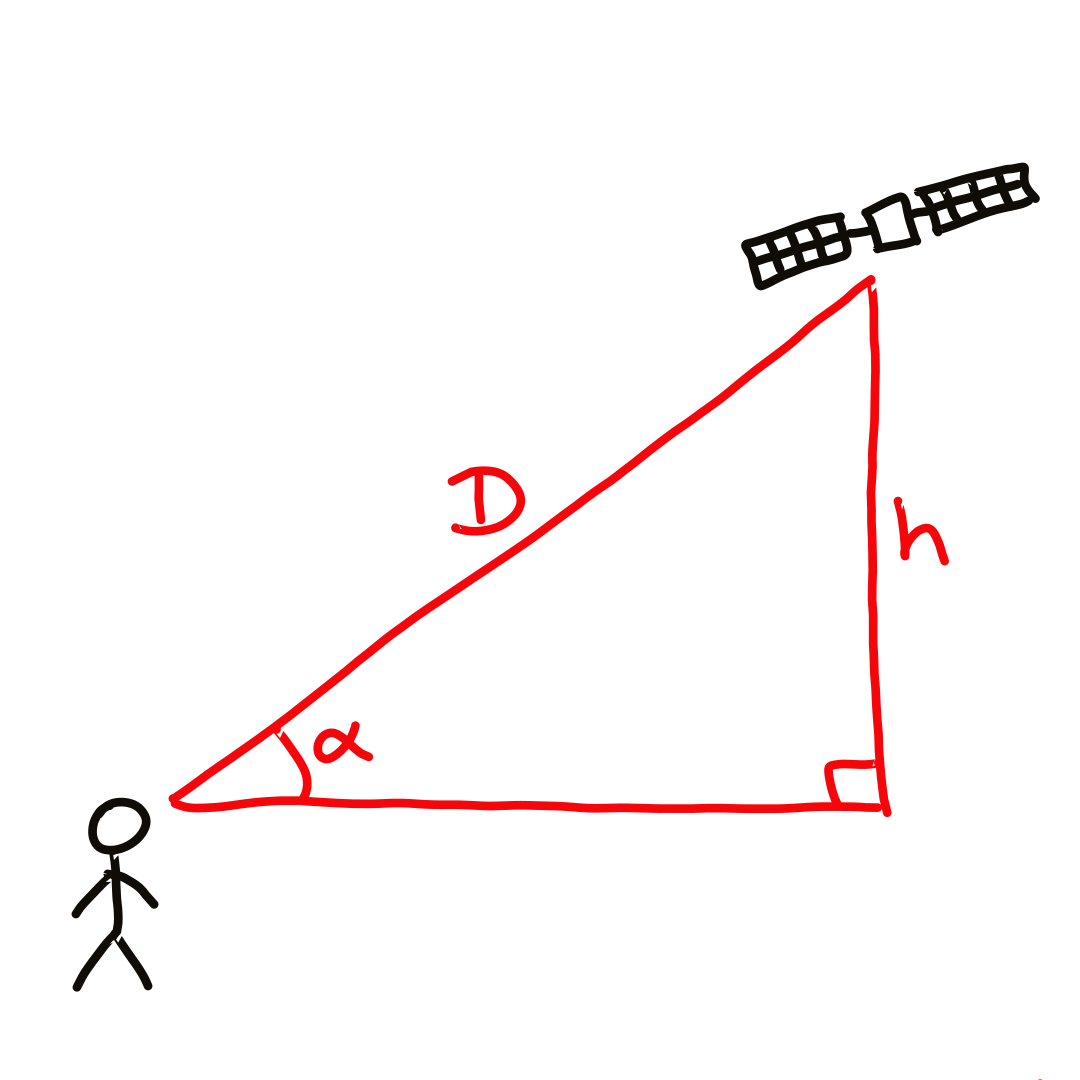
But we already measured the angular velocity around the observer:
\[\begin{align} \omega &= \frac{\Delta \theta}{\Delta t} \\ &= \frac{40.1^\circ}{52\,\mathrm{s}} \\ &= 1.3 \times 10^{-2}\,\mathrm{rad/s} \\ \end{align}\]Now we can use Newton’s laws to find the speed of the satellite. The satellite is at a distance $R+h$ from the center of the Earth, where $R$ is the radius of the Earth. By equating the force of gravity to the centripetal force, we obtain:
\[\begin{align} &&G\frac{Mm}{(R+h)^2} &= m \frac{v^2}{R+h} \\ &\implies& G\frac{M}{R+h} &= v^2 \\ &\implies& v &= \sqrt{\frac{GM}{R+h}} \end{align}\]From this, we can make several substitutions:
\[\begin{align} && \omega &= \frac{v}{D} \\ &\implies& \omega &= \frac{v}{h \sin(\alpha)} \\ &\implies& \omega h \sin(\alpha) &= v \\ &\implies& \omega h \sin(\alpha) &= \sqrt{\frac{GM}{R+h}} \\ &\implies& \omega^2 h^2 \sin^2(\alpha) &= \frac{GM}{R+h} \\ &\implies& h^2 (R + h) &= \frac{GM}{\omega^2 \sin^2(\alpha)} \\ \end{align}\]We know the values of the gravitational constant $G$ and the mass $M$ of the Earth. Together, they yield $GM = 3.99 \times 10^{14}\,\mathrm{m}^3/\mathrm{s}^2$. And since we know the values of $\omega$ and $\alpha$, we have all the variables needed to calculate the right hand side of the equation above:
\[\frac{GM}{\omega^2 \sin^2(\alpha)} = 2.9 \times 10^{18}\,\mathrm{m}^3\]Since the radius of the earth is $R = 6371\,\mathrm{km}$, we can now solve our cubic equation:
\[\begin{align} && h^2 (R + h) &= 2.9 \times 10^{18}\,\mathrm{m}^3 \\ &\implies& h &= 6.5 \times 10^5\,\mathrm{m} \\ \end{align}\]Thus, the satellite is flying $\sim 700\,\mathrm{km}$ above the surface of the Earth. If we do a Google search on CZ-2C R/B, we see that our calculation is spot-on.