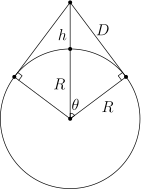
The horizon is the point where your line of vision is tangent to the surface of the earth. We can use a simple geometric construction to figure out how far the horizon is based on how high your line of sight is.
Define the following variables:
- $R$: radius of the earth
- $h$: height of your line of sight
- $D$: distance to the horizon
Since your line of sight is tangent to the surface of the earth, it forms a right triangle as shown in the diagram. Thus, we can use the Pythagorean theorem:
\[\begin{align} && D^2 + R^2 &= (h + R)^2 \\ &\implies& D &= \sqrt{(h+R)^2 - R^2} \\ &\implies& \Aboxed{D &= \sqrt{2Rh + h^2}} \\ \end{align}\]And if $h \ll R$, as in every-day life, we can simply say:
\[\boxed{D \approx \sqrt{2Rh}}\]How much does the straight-line distance differ from the arc-length distance?
The arc-length distance to the horizon is given by:
\[\begin{align} s &= R \theta \\ &= R \,\arccos(\frac{R}{R+h}) \\ &= R \,\arccos(\frac{1}{1 + \frac{h}{R}}) \\ \end{align}\]And since $h \ll R$, we can use a Taylor approximation for $\arccos$, along with some other approximations along the way:
\[\begin{align} && \arccos(x) &\approx \sqrt{1 -x^2} \inlinetext{for} x \to 1 \\ &\implies& s &\approx R \sqrt{1 - \qty(\frac{1}{1 + \frac{h}{R}})^2} \\ && &\approx R \sqrt{1 - \qty(1 - \frac{h}{R})^2} \\ && &= R \sqrt{2 \frac{h}{R} - \qty(\frac{h}{R})^2} \\ && &= \sqrt{2Rh - h^2} \\ && &\approx \sqrt{2Rh} \\ \end{align}\]Therefore, we see that in every-day life, the arc-length distance does not differ significantly from the straight-line distance.
A rubber band all around the world
Now we can pose another fun question. If we place a giant rubber band all around the circumference of the earth, and then grab one point and elevate it off the ground by one meter, how much will the rubber band stretch?
The unstretched distance is clearly the circumference of the earth. But for the stretched distance, we need to take that circumference, subtract the circle arc where the rubber band is not touching the ground, and add the corresponding straight line distance of the elevated rubber band. In other words,
\[L_\mathrm{stretched} = 2\pi R - 2\theta R + 2 D\]Now we can plug in $\tan(\theta) = \frac{D}{R}$, and use the small-height approximation for $D$ to obtain:
\[L_\mathrm{stretched} = 2\pi R - 2 R \arctan\qty(\frac{\sqrt{2Rh}}{R}) + 2 \sqrt{2Rh}\]Now, we can take the difference between stretched and unstretched:
\[\begin{align} \Delta L &= L_\mathrm{stretched} - L_\mathrm{unstretched} \\ &= 2\sqrt{2Rh} - 2R\arctan\qty(\frac{\sqrt{2Rh}}{R}) \\ \end{align}\]And since $h = 1\,\mathrm{m}$ and $R = 6371\,\mathrm{km}$, this yields a surprisingly small result:
\[\boxed{\Delta L \approx 0.7\,\mathrm{mm}}\]