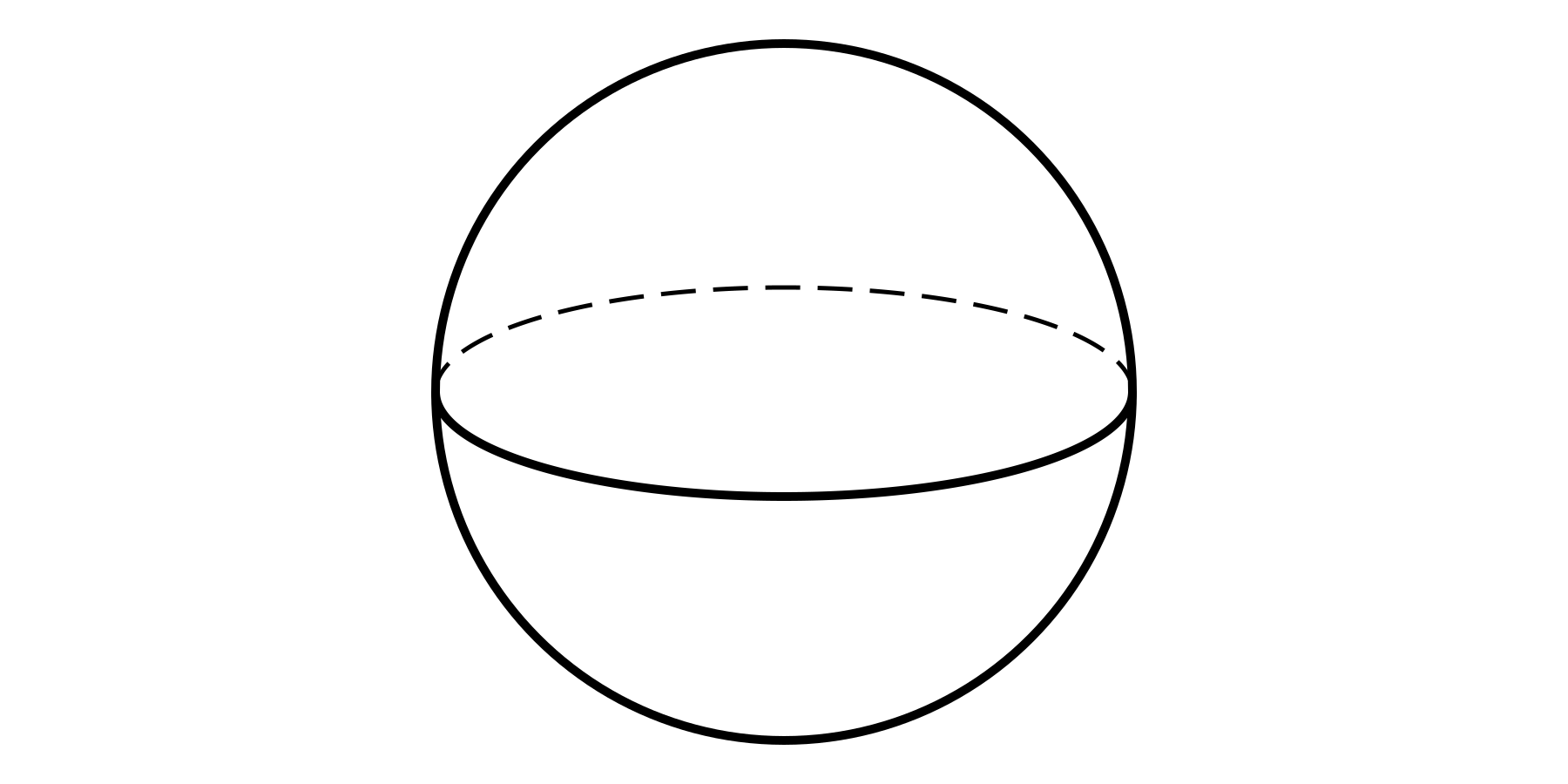
Let us derive the volume of an $n$-dimensional sphere. First, we shall consider the product of $n$ copies of the Gaussian integral, which yields a known value:
\[\begin{align} && \sqrt{\pi} &= \int\limits_{-\infty}^\infty e^{-x^2} \dd{x} \\ &\implies& \qty(\sqrt{\pi})^n &= \qty(\int\limits_{-\infty}^\infty e^{-x^2} \dd{x} )^n \\ &\implies& \pi^\frac{n}{2} &= \int\limits_{-\infty}^\infty e^{-x_1^2} \dd{x_1} \int\limits_{-\infty}^\infty e^{-x_2^2} \dd{x_2} \ldots \int\limits_{-\infty}^\infty e^{-x_n^2} \dd{x_n} \\ &\implies& \pi^\frac{n}{2} &= \int\limits_{-\infty}^\infty \int\limits_{-\infty}^\infty \ldots \int\limits_{-\infty}^\infty e^{-x_1^2-x_2^2\ldots-x_n^2} \dd{x_1}\dd{x_2}\ldots\dd{x_n} \\ &\implies& \pi^\frac{n}{2} &= \int\limits_{\mathbb{R}^n} e^{-r^2} \dd{V_n} \\ \end{align}\]So we see that this integral takes a simple form if we let $r^2=x_1^2+x_2^2\ldots+x_n^2$ relate the distance from the origin, and $\dd{V_n}=\dd{x_1}\dd{x_2}\ldots\dd{x_n}$ be the $n$-dimensional volume element. But in polar coordinates, the volume element $\dd{V_n}$ can be separated into a radial $\dd{r}$ part, which is integrated along the radius from the origin, and an angular $r^{n-1} \dd{\Omega_{n-1}}$ part, which is integrated over the $(n-1)$-dimensional surface $S^{n-1}$ of the $n$-dimensional unit sphere. Hence:
\[\begin{align} && \dd{V_n} &= \qty(\dd{r}) \qty(r^{n-1} \dd{\Omega_{n-1}}) \\ &\implies& \pi^\frac{n}{2} &= \int\limits_0^\infty e^{-r^2} r^{n-1} \dd{r} \int\limits_{S^{n-1}} \dd{\Omega_{n-1}} \\ &\implies& \pi^\frac{n}{2} &= \Omega_{n-1} \int\limits_0^\infty e^{-r^2} r^{n-1} \dd{r} \\ &\implies& \pi^\frac{n}{2} &= \Omega_{n-1} \int\limits_0^\infty e^{-u} \qty(\sqrt{u})^{n-1} \frac{\dd{u}}{2\sqrt{u}} \where u = r^2 \\ &\implies& \pi^\frac{n}{2} &= \frac{1}{2} \Omega_{n-1} \int\limits_0^\infty e^{-u} u^{\frac{n}{2}-1} \dd{u} \\ &\implies& \pi^\frac{n}{2} &= \frac{1}{2} \Omega_{n-1} \Gamma\qty(\frac{n}{2}) \\ &\implies& \Omega_{n-1} &= \frac{2 \pi^\frac{n}{2}}{\Gamma\qty(\frac{n}{2})} \\ \end{align}\]So we have solved for $\Omega_{n-1}$, which is the surface area of the unit sphere $S^{n-1}$. We can generalize it to yield the surface area for any radius $r$ by simply scaling it appropriately:
\[A_{n-1}(r) = \Omega_{n-1} r^{n-1} = \frac{2\,\pi^\frac{n}{2}}{\Gamma\qty(\frac{n}{2})} r^{n-1}\]And if we integrate with respect to $r$, we recover the volume of an $n$-sphere:
\[\begin{align} && V_n(r) &= \int A_{n-1}(r) \dd{r} \\ && &= \frac{2\,\pi^\frac{n}{2}}{\Gamma\qty(\frac{n}{2})} \int r^{n-1} \dd{r} \\ && &= \frac{2\,\pi^\frac{n}{2}}{n \,\Gamma\qty(\frac{n}{2})} r^n \\ && &= \frac{\pi^\frac{n}{2}}{\qty(\frac{n}{2})\Gamma\qty(\frac{n}{2})} r^n \\ &\implies& \Aboxed{V_n(r) &= \frac{\pi^\frac{n}{2}}{\Gamma\qty(\frac{n}{2}+1)} r^n} \end{align}\]