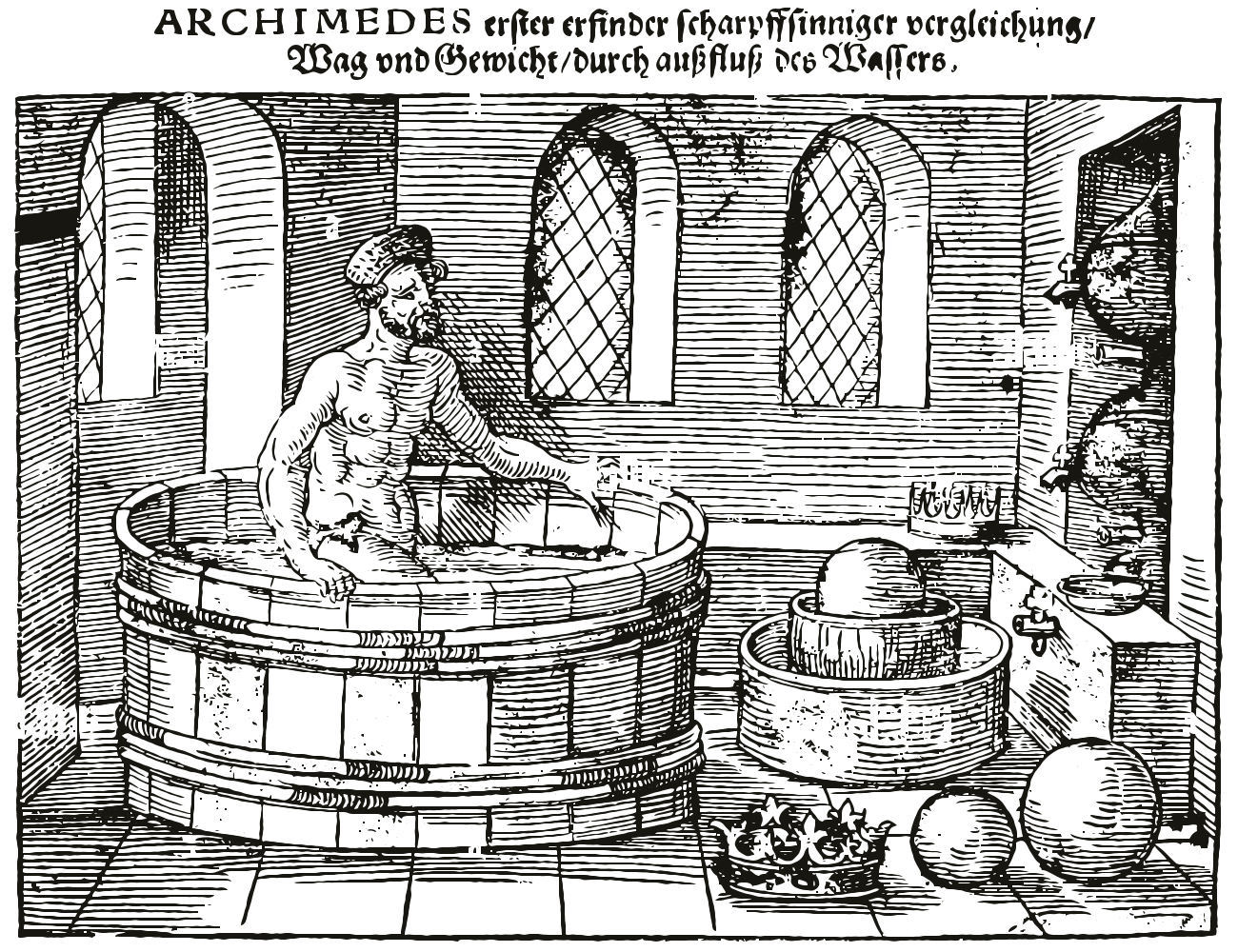
Two thousand years ago, Archimedes had his famous eureka moment, where he discovered that one could measure arbitrary volumes by the water that they displace when submerged. Eventually, this led to him discovering the Principle of Buoyancy, which states that the buoyant force acting on a submerged object is equivalent to the weight of the water it displaces. In this post, we will derive this result from first principles. Our derivation will show that the buoyant force arises due to the pressure gradient of water.
How pressure varies with depth
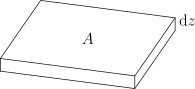
We must first determine how water pressure changes with depth. Let the coordinate $z$ denote depth, with $z = 0$ marking the surface of the water, and a positive $z$ when underwater. From real life experience, we know that pressure $P$ increases the deeper we go. Therefore, let us examine some rectangular volume of water with area $A$ and height $\dd{z}$. Recalling that pressure is force per unit area, the top of the rectangle feels a downward force $-A\,P$, while the bottom of the rectangle feels an upward force $A\,(P+\dd{P})$. Moreover, the rectangular volume of water feels its own weight $w = - \rho A \dd{z} g$, where $\rho$ is the density of water, and $g$ is Earth’s gravitational acceleration. Since this is a static system, the sum of all forces should cancel out:
\[\begin{align} && \sum\limits_i F_i &= 0 \\ &\implies& -A\,P + A\,(P+\dd{P}) - \rho A \dd{z} g &= 0 \\ &\implies& P(z + \dd{z}) - P(z) &= \rho g \dd{z} \\ &\implies& \dv{P}{z} &= \rho g \\ &\implies& \Aboxed{P &= P_0 + \rho g z} \\ \end{align}\]where $P_0$ represents the pressure at the surface, which is equal to atmospheric pressure.
The buoyant force
We can generalize the differential equation above using the gradient operator. Let $\vb{g} = -g \,\vu{z}$. Then, since $P$ only depends on the $z$ coordinate, we can write:
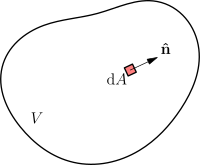
\[\grad P = \rho \vb{g}\]Now, suppose we have some arbitrary volume $V$ submerged in the water. Then, the pressure of the water will exert an inward force upon each infinitesimal surface element $\dd{A}$. If $\vu{n}$ is the unit vector normal to the area element $\dd{A}$, then the force is in the direction of $-\vu{n}$. Using a corollary of the divergence theorem, we can write the buoyant force acting on the volume as:
\[\begin{align} && \vb{F}_\mathrm{buoyant} &= - \oiint\limits_S \vu{n}P \dd{A} \\ && &= -\iiint\limits_V \grad P \dd{V} \\ && &= -\iiint\limits_V \rho \vb{g} \dd{V} \\ && &= -\rho\vb{g} \iiint\limits_V \dd{V} \\ &\implies& \Aboxed{\vb{F}_\mathrm{buoyant} &= -\rho V \vb{g}} \\ \end{align}\]Therefore, we see that the buoyant force has a magnitude equivalent to the weight of the water displaced by the submerged object, which is precisely what Archimedes discovered two thousand years ago.